


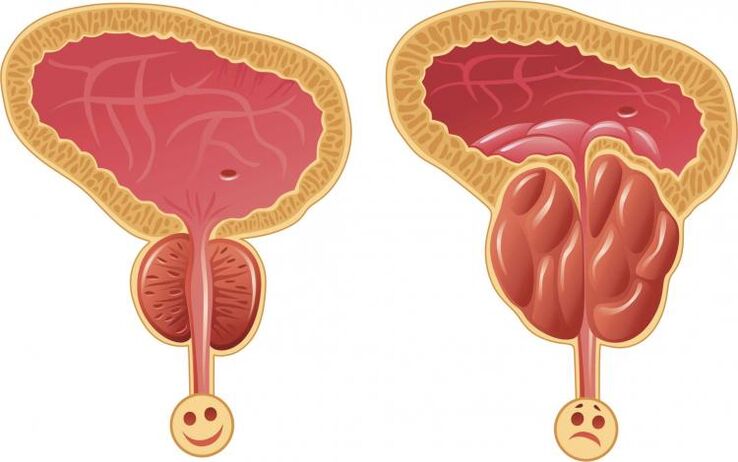
Prostatitis in men belongs to the group of andrological (exclusively male) urogenital pathologies.The disease occurs in the form of acute or chronic inflammation.This is the most common urological disease today.Previously, it was believed that it manifests itself only at the age of 45-65, but now doctors are increasingly diagnosing prostatitis in young people at the age of 20-30.The disease has significantly rejuvenated.
The nature of the prostate lesion depends on the sexual habitus of the person.
- The prostate can theoretically be affected in boys before puberty, but inflammation of the underdeveloped gland is not considered an independent disease.
- In men who are sexually active, prostatitis often occurs as an acute inflammation.
- Pathology of the gland, in mature and elderly people, can be manifested in the form of three independent diseases (chronic prostatitis, adenoma - benign hyperplasia, adenocarcinoma - malignant hyperplasia).
- In people who have undergone (chemical, physical, radiation) castration, the gland is atrophied.
The prostate is an accessory gland of the male reproductive organ.It is located at the junction of the urethra and the ejaculatory ducts.The significance of the gland before puberty has been little studied.In a mature man, the prostate:
- produces a secretion that dilutes the sperm, ensures the viability of the sperm in the female genital tract;
- produces prostaglandins, substances that promote increased blood supply to the sexual organ before the onset of erection, together with the testicles participates in the production of the hormone testosterone;
- ensures rapid evacuation (release) of sperm from the urethra and participates in the formation of orgasm;
- through reflex mechanisms it prevents the entry of urine into sperm during sexual excitement and participates in the complex mechanism of erection.
The prostate is a sensitive organ to pathogens.It is inevitably involved in the pathology of the walls of the urethra, bladder and vas deferens.The strong flow of blood and lymph circulating through the branched vascular system of the damaged gland causes stagnation, swelling of organs and worsens the pathology.The gland is well innervated, damage is accompanied by pain.
What men should know about prostatitis
Prostatitis is an inflammatory disease of the prostate (prostate), most often caused by an infectious agent that enters the prostate from the urethra itself, the bladder and the nearby rectum.However, infection in itself does not mean the development of disease;for that, as they say, a "favorable combination of circumstances" is necessary.
What factors predispose to the occurrence of prostatitis:
- Long-term sedentary work and sedentary lifestyle.The risk group includes drivers, programmers and all those who spend their working day without getting up from their chair to walk and warm up.
- Regular bowel dysfunction in the form of constipation.
- Severe or repeated hypothermia of the whole body.
- Excessively active sex life or prolonged abstinence.Both are not at all beneficial for the normal functioning of the prostate.
- Overeating, abuse of spicy food and alcohol, constant stress.
The prostate is a very small organ, 3 cm long and 4 cm wide.It weighs only 20-25 grams.However, prostate secretion has bactericidal properties, so the inflammatory process in the gland can develop only in the presence of stagnation in this organ, when its secretion loses its properties.
How does prostatitis manifest itself in men?
There are chronic and acute forms of prostatitis:
- Symptoms of acute prostatitis are characterized by severe inflammation in the prostate area.In this case, the patient has a high temperature (body temperature rises to 38-39 degrees), pain in the groin and perineum, painful urination and defecation.
- Chronic prostatitis worries men less, so they may not immediately pay attention to the signs characteristic of the disease.The patient's body temperature occasionally rises to 37 degrees, sometimes he is troubled by discomfort when going to the toilet, and a little mucus or pus is released from the urethra.Such discharge is one of the typical signs of chronic prostatitis.
Signs of prostatitis in men
There are six signs (precursors) of prostatitis - dysuria syndrome.Use as clinical markers is conditional.However, the presence of two of the six symptoms is a reason to consult a urologist.
- The stream of urine falls slowly or the distance is less than 20 cm.
- Difficulty, drop by drop, urination.
- Pain when urinating.
- Intermittency, bifurcation, jet spraying, process duration.
- A feeling that the bladder is not completely empty.
- Frequent urination at night.
It is strictly forbidden to draw clinical conclusions when identifying these signs.Prostatitis has a complex pathogenesis, which involves different mechanisms.You cannot treat a disease based on general clinical symptoms.Contact a urologist to determine the symptoms, nature of damage, stage of the disease and prescribe treatment.Diagnosis and treatment are carried out taking into account the organs and systems involved in pathogenesis.In some cases, consultation with a venereologist, surgeon or oncologist is necessary.
Symptoms of prostatitis in men
Prostatitis can occur in the form of acute and chronic inflammation.Acute forms develop according to the type of catarrhal, follicular, parenchymal inflammation.Manifestations of chronic prostatitis are associated with concomitant diseases.
Symptoms of prostatitis, revealed by clinical methods and functional tests.The following symptoms are of utmost importance for recognizing the nature of the pathology, causes and mechanisms of the body's defense reactions.
- Frequent urination with prostatitis.In a healthy person, the maximum number of urges to urinate does not exceed 10-12 times a day, usually 4-5 times.The daily volume of urine in a healthy adult is 1000-2000 ml.The amount of urine at which the urge occurs is 120-170 ml;accumulation of urine greater than 350 ml causes a strong desire to empty the bladder.The products of inflammation of prostatitis constantly irritate the receptors of the walls of the urinary organs, which results in urination:
- Frequent urination (polakiuria), while the daily volume of urine has not increased;
- By urinating in small portions, inflammatory products send false signals to the receptors about filling a half-empty bladder, after emptying the feeling of its fullness remains;
- Painful urination (strange), due to narrowing of the urethra by an inflamed prostate;
- Difficulty urinating due to compression of the urethra by an inflamed gland, sometimes prostatitis is accompanied by the inability to empty the bladder (ischuria);
- Nocturnal urination (nocturia), irritated bladder walls, send a constant signal for urine production.
- Temperature with prostatitis.An increase in body temperature to subfebrile and febrile levels is typical.High temperature accompanies purulent prostatitis in the early stages of septic shock.In the late phase of septic shock, on the contrary, low temperature (hypothermia) up to 35-36°C is characteristic.Low temperature is dangerous for humans due to the propensity of platelets to disseminated intravascular coagulation (DIC syndrome).The prognosis of prostatitis complicated by sepsis in the presence of DIC syndrome is cautious or unfavorable.
- Blood in the urine with prostatitis.The symptom of hematuria (blood in the urine) is a rare but very dangerous sign.Persistent bleeding is difficult to stop.There are several causes of hematuria with prostatitis, including:
- purulent dissolution of the gland with a section of blood vessel and perforation of a vessel in the urethra;
- accidental injury during instrumental examination of genitourinary organs;
- prostatitis, complicated by hyperplasia, often malignant.
- Pain syndrome.Complicated prostatitis is accompanied by pain outside urination.Sometimes the pain occurs periodically, for example during a bowel movement.The cause of the pain is the constant irritation of the gland by the products of inflammation.Dull (aching) pain in the perineum and anus is often noticed.
Laboratory tests that confirm the symptoms of prostatitis.It is used to clarify the presence of inflammation, determine the severity of the inflammatory and septic process.
- General blood test.Indicators that confirm prostatitis are: an increase in the number of leukocytes, a shift in the leukogram towards an increase in the number of banded blood cells, an increase in ESR.
- Urinalysis.It detects hidden pyuria (pus in the urine) and bacteriuria (bacterial contamination) in the first portion of urine.Use the three-glass method to identify hidden pus and bacteria at the beginning, middle, or end of urination.Repeated bacteriological examination of urine, at intervals of several days, is carried out in order to determine changes in the type of bacterial flora.
- Container for blood cultures.The method is indicated for symptoms of progressive sepsis accompanied by debilitating (hectic) fever.
- Studying the cellular link of immunity in prostatitis complements the understanding of the nature of pathogenesis and predicts the likelihood of developing sepsis.
Instrumental methods used to clarify the symptoms of prostatitis.The following methods have diagnostic value.
- Method of transrectal (through the rectum) ultrasound examination (TRUS).Its high diagnostic value is emphasized.The method has contraindications associated with the prohibition of gland massage in certain stages of the disease.
- X-rays of the bladder.Choose projections suitable for examining the prostate.Before the image is taken, urographin, a radiopaque substance inert to the body, is injected into the bladder.
- Prostate puncture biopsies have strictly limited indications for prostatitis.
Causes of prostatitis in men
There are several groups of causes of prostatitis, including:
- Complications of past diseases in men (PPP infections, colds of the pelvic organs, complicated by staphylococcal or other bacterial infections, viral, fungal agents, especially on the background of reduced immunity and general resistance of the organism), chronic gynecological infections in a woman - a sexual partner.
- Urethral reflux.A disorder in the prostate's ability to prevent urine from returning to the genital canals is called urethral reflux.As a result, bacterial contamination of the prostate occurs.Urethral reflux is a consequence of improper catheterization, as well as previous inflammation of the urethra.In this case, urethrorrhagia occurs - a pathological increase in the lumen of the urethra.Urethral-vesiculoseminal reflux, bacterial contamination is combined with stone formation in the prostate and ejaculatory ducts.
- Disruption of the rhythm of sexual life, including lack or excess of sex, regular delayed ejaculation.
- Stagnation of venous blood in the genitourinary organs of the small pelvis of men is a consequence of a sedentary lifestyle (hemorrhoids, sexual dysfunction, other reasons);
- Hormonal imbalance associated with insufficient production of male hormones by the gonads, resulting in a general weakening of skeletal and smooth muscle tone, impaired erectile function and other disorders.
Classification of prostatitis
There are bacterial and non-bacterial prostatitis:
- Bacterial prostatitis is caused by pathogenic microorganisms that enter the prostate from the outside.These include streptococci, staphylococci, Escherichia coli, Proteus and others.Many bacteria are the normal flora of our body, but under certain conditions they enter the prostate and cause an inflammatory process.Prostatitis can also develop as a result of sexually transmitted diseases such as chlamydia, ureaplasmosis, gardnerellosis, trichomoniasis, gonorrhea, mycoplasmosis.
- The group of non-infectious prostatitis includes:
- Congestive (stagnant) prostatitis.It is caused by congestion in the pelvis.Incomplete ejaculation, sexual excesses, prolonged abstinence, interrupted sexual intercourse - all this contributes to venous stagnation in the pelvic organs.
- Sclerotic prostatitis.It is characterized by a decrease in the size and function of the prostate, compaction of its tissues as a result of the death of prostate cells and their replacement by sclerotic tissue.One of the reasons for the occurrence of this form of the disease is frequent constipation, taking certain medications and multiple infections.Such prostatitis, unfortunately, cannot be treated.
- Calculous prostatitis.The result of the development of calculous prostatitis is the presence of phosphate and oxalate stones in the gland.Reaching large sizes, they cause sharp pain in the urethra.The treatment method involves dissolving the stones that form.
- Prostatopotic prostatitis.This disease causes chronic pelvic pain, but its etiology is not fully understood.It is believed to be caused by reverse secretion flow, perineal muscle damage, bladder neck pathology, and psychological factors.
- Atypical forms.In the atypical form, the patient may complain of pain in the legs, lower back and sacrum, which is unusual for the characteristic symptoms of prostatitis.The outcome of the treatment depends on the duration of the disease, the activity of inflammatory processes and the presence of additional complications.
If prostatitis is not treated, then in an advanced form it leads to a decrease in potency, infertility, depression, debilitating pain in the perineum and other complications.
How dangerous is prostatitis, the consequences of prostatitis
The consequences depend on age, the state of the immune system and the presence of bad habits.Therefore, in people of the older age group, with weakened immunity, with a history of alcoholism, drug addiction, acquired immunodeficiency syndrome, the consequences of the disease are more severe.
- The effect of prostatitis on potency.A damaged gland, with decompensation of functional activity, reduces the production of substances involved in the creation of an erection in the male genital organ.The consequence of prostatitis is a slowed release of seminal fluid during sexual intercourse, a decrease in the fullness of sensation during sexual intercourse, and in advanced forms, erectile dysfunction.
- The effect of prostatitis on conception.A damaged prostate sharply reduces the activity of producing high-quality secretions necessary to maintain the activity of sperm in the woman's birth canal.The secretion of an inflamed prostate, when it enters the genital canal of a woman during sexual intercourse, reacts with immune rejection of the female body, development of gynecological diseases and impossibility of conception.
- Prostatitis causes damage within the gland and the body.Inflammation complicated by microflora increases the risk of prostate abscess.The formation of an abscess is a purulent dissolution of part of the parenchyma of the gland with the formation of a capsule around the lesion.The disease with the formation of mineralized stones in the cavity is a consequence of the prostate complicated by the reflux of a damaged prostate.The consequences of prostatitis are: acute ischuria, urolithiasis, kidney failure, inflammation of the genitourinary organs and other diseases.
Is it possible to have sex with prostatitis?
It has been proven that the disruption of the rhythm of intimate life is one of the causes of inflammation of the gland.Regular ejaculation of moderate frequency has a positive effect on the pathogenesis of prostatitis with subclinical and moderate clinical manifestations of prostatitis.Some medical procedures and disease stages require a temporary ban on sexual activity.Detailed recommendations should be obtained from your doctor.Have sex if you have prostatitis, maintain moderation and safety in your intimate life.
Is prostatitis sexually transmitted?Prostatitis is a purely male disease that does not have a specific viral, bacterial or fungal origin.Meanwhile, inflammation of the prostate is a danger to gynecological health.Seminal fluid containing inflammatory products that enter the female genital organs, against the backdrop of a reduction in the protective barriers of the birth canal, is a real threat to conception and pregnancy.A healthy lifestyle and reliable male contraception are a simple way to protect sexual partners from mutual problems.
Is it possible to cure prostatitis once and for all?
Most of those men who have been repeatedly treated for prostatitis are interested in one question - is it possible to get rid of this unpleasant disease forever.According to experts, the effectiveness of treatment largely depends on the presence and severity of irreversible consequences in the prostate.These can be scars, stones, calcifications.
Further development of the inflammatory process can be stopped in the early stages only by timely consultation with a doctor.In this case, irreversible complications do not develop on the prostate and there is a possibility of a complete cure.When areas of sclerotic tissue - scars - are already formed, there are calcifications and small stones that cannot be removed, then, most likely, re-inflammation can occur.This is chronic prostatitis.
In addition to treatment, an important factor in overcoming this disease is the patient's willingness to change his current lifestyle - irregular sex life and constant sitting on a chair.If he does not want such changes, then with a high degree of confidence we can say that the inflammatory process will soon return again.The idea that prostatitis is incurable is related to the patient's unwillingness to eliminate these negative factors from his life.
The duration and regimen of treatment is determined by the doctor, based on the results of physical, laboratory and instrumental studies.Treatment of prostatitis is based on antibacterial drugs.The use of vitamins, physiotherapeutic procedures, anti-inflammatory, painkillers, antibiotics is indicated.
Diet for prostatitis
Following a diet, using a certain set of products:
- reduces pain,
- improves microcirculation of blood and lymph in the vessels of the gland,
- strengthens the body's protective functions,
- normalizes bowel function,
- reduces the formation of urine at night.
Products for prostatitis.Decommission:
- Strong coffee, spicy dishes - increase blood flow to the gland, stimulate pain;
- Fats, fatty meat, eggs, flour - increase the deposition of cholesterol on the capillary walls, reduce the microcirculation of blood flow in the gland;
- Alcoholic beverages reduce immunity;
- Products containing coarse fibers, salty, spicy food - change intestinal motility;
- A large amount of liquid (in the evening), salty, smoked food (during illness) - increase the volume of liquid and retain it in the body.
It is recommended to include in the diet: vegetable salads seasoned with olive oil, vegetables and fruits grown in the region of residence, natural juices, nuts, dried fruits, lean cooked meat.The range of products for prostatitis can be checked with a nutritionist.
Preventive measures
Prevention is based on simple rules that are easy to follow.
- Take regular long walks (this style of walking is the most physiological);
- Eat right, lead a healthy lifestyle;
- Use male contraception.
To avoid the development of prostatitis and its complications, immediately consult a urologist for any diseases of the genital organs.It is also not necessary to wait for any symptoms to appear, but to visit a doctor at least once a year.You will undergo an examination at a health facility and you will know for sure that everything is fine with your sexual health.
Those who suffer from constipation, abuse alcohol, spicy and smoked food, those who do not actively play sports and those who have a history of sexually transmitted diseases should not delay visiting a urologist.Due to the high risk of disease, such persons should undergo a mandatory examination, even if there are no indications for it.
As you know, men do not like to go to the doctor, and when it becomes unbearable, it turns out that the disease has taken a chronic course.But the course of treatment could have been completed much earlier.Now chronic prostatitis will have to be treated for at least 1-2 months.